
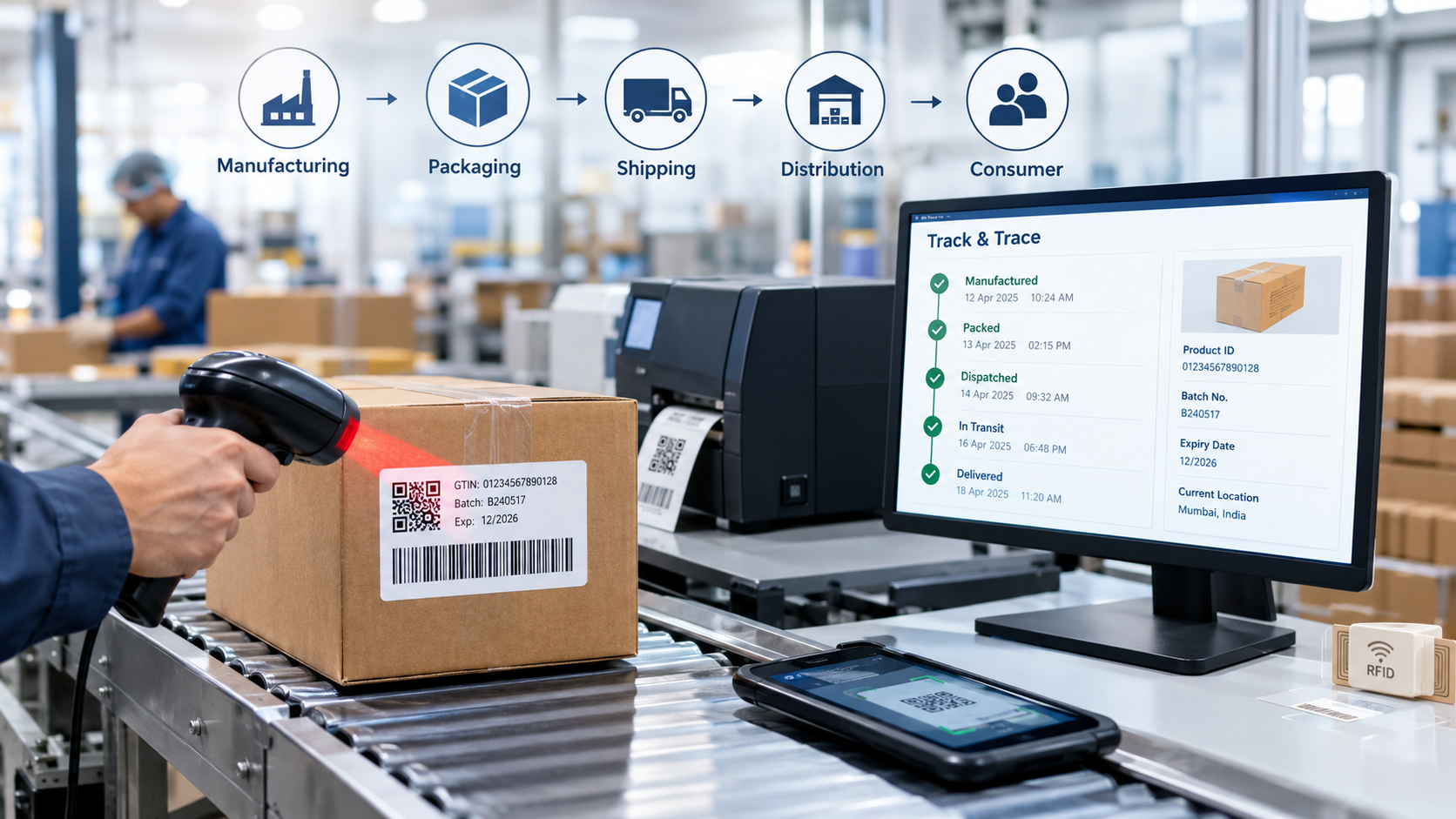
Track and trace technology lets a business follow a product from the moment it is made to the moment it is consumed, and reconstruct its full history when something goes wrong. A track and trace system combines labels, scanners, software and data so every unit, batch or pallet has a record you can pull up in seconds. For manufacturers, pharma companies and logistics operators, it is the difference between a targeted recall and a full-stock panic.
This guide explains how the technology works, which technologies are used, what a complete system includes and how to choose one.
Two ideas sit inside the term:
Track and trace technology links the two. Each item gets a unique identifier, usually a 2D barcode or an RFID tag. Every time that identifier is scanned, the system records the event, and over time those records build the product’s full history. People also call this a track and trace system, a traceability system or, in regulated industries, a serialization system.
| Technology | Best for | Limitations |
| 1D and 2D barcodes, QR codes | Low-cost unit and case identification, serialization | Needs line of sight and a clean print |
| RFID | Pallets, returnable assets, reading many items at once | Higher tag cost; metal and liquids can interfere |
| Serialization and aggregation | Regulated products needing unit-level records | Needs software and strict process discipline |
| GPS and IoT sensors | In-transit location, temperature and condition | Needs connectivity and costs more per asset |
Most businesses combine several. For example, 2D codes identify individual units, RFID tracks pallets and GPS covers transport. If you are weighing barcodes against RFID, see our guide to RFID for inventory management and the importance of barcode and RFID systems. For sensor-based tracking on the shop floor, look at our Industry 4.0 and IIoT solution.
Pharmaceuticals. Unit-level serialization, authenticity checks and batch records. Read our guides to track and trace for liquor and pharmaceuticals and 21 CFR warehouse management for pharma, or see our pharmaceutical industry solutions.
Food and beverage. Batch and expiry tracking from raw material to dispatch. Explore our food and beverage solutions and frozen food barcode and RFID guide.
Manufacturing. Raw material, work-in-progress and finished-goods traceability. See our manufacturing solutions and WIP tracking software guide.
Logistics. Shipment status, gate-in and dispatch records, and proof of delivery. See our transport and logistics solutions.
The rules have changed recently, so check them before you plan a project. India’s DGFT withdrew its track and trace provisions for pharmaceutical exports, and the Health Ministry now leads, having already required barcodes or QR codes on 300 drug brands from 1 August 2023. Most export destinations also have their own serialization requirements. biovoicenewsbiovoicenews
In practice, pharma exporters should confirm two things: what the Drugs Rules require for their domestic brands, and what the destination market (for example the US or EU) requires for serialized packs. Other industries, such as food and chemicals, usually trace for recalls, customer requirements and audits rather than a single national mandate.
A practical shortcut is to start with one product line, prove the process and then expand to other lines and sites.
Tracking shows where a product is now. Tracing reconstructs where it has been and where it came from.
No. Serialization gives each unit a unique code. Track and trace uses those codes to record and retrieve movement history.
Barcodes cost less and work for most products. RFID suits pallets, reusable assets and high-volume reading. Many businesses use both.
Pharma faces the strictest rules, but food, chemicals, manufacturing, automotive and logistics all use it for recalls, quality control and customer requirements.
It depends on your line setup, integrations and number of sites. A single-line pilot is typically much faster than a multi-plant rollout.
Many lines can be upgraded with printers, applicators and fixed readers. A line audit shows what you can reuse.
Raj Barcode supplies the full stack, from printers and scanners to software and integration. See the Track & Trace solution or contact our team for a requirements discussion.